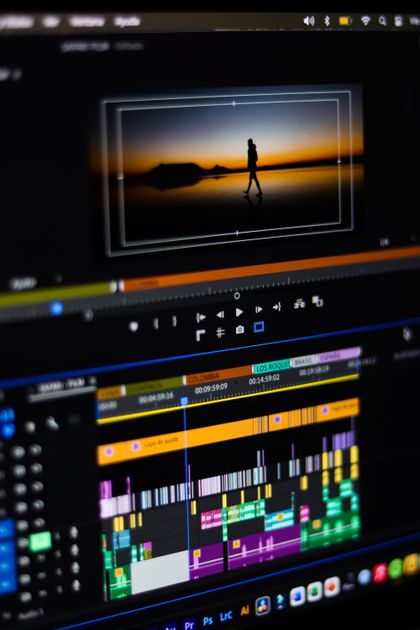
Most editors assume they spend too much time inside Premiere Pro because editing is inherently slow.
That's rarely the real problem.
Professional documentary editors don't become dramatically faster because they click more quickly. Or memorize more keyboard shortcuts. Or own faster computers.
They become faster because they stop asking the timeline to solve problems it was never designed to solve.
The timeline is an incredible place to assemble a story. It's an expensive place to discover one.
That distinction changes almost every editorial workflow. Because many hours spent "editing" aren't actually editing at all. They're searching. Comparing. Remembering. Testing. Second-guessing. Trying to answer questions that should have been resolved much earlier.
Professional editors gradually move those decisions upstream. The result isn't simply faster editing. It's better storytelling.
The Timeline Encourages Commitment
One reason editors lose so much time is psychological.
The moment clips enter a timeline, they begin feeling permanent. Even when they aren't.
Imagine you've spent thirty minutes assembling a sequence. You trimmed interviews. Added temporary B-roll. Adjusted transitions. Maybe even cleaned the audio.
Now someone suggests removing the entire section.
Technically, that's easy. Emotionally, it isn't.
You've already invested work. The timeline quietly encourages commitment.
That's why experienced editors delay entering it until they've answered as many structural questions as possible. The less uncertainty they carry into the timeline, the fewer expensive revisions they create later.
Searching Isn't Editing
Think about how much time disappears during a typical documentary project.
Looking for that interview answer. Trying to remember who mentioned a particular event. Comparing three versions of the same explanation. Reopening transcripts. Watching another interview because maybe there's a better quote.
None of those activities are actually editing. They're retrieval.
Necessary? Absolutely. But fundamentally different.
Professional editors work hard to separate retrieval from editorial decision-making. Because every minute spent searching inside the timeline interrupts narrative thinking.
Instead of asking, "How should this scene work?" the editor begins asking, "Where did that clip go?"
That's one of the most expensive context switches in documentary editing. For a deeper look at how transcript-based workflows separate retrieval from decision-making, see our guide to editing interview transcripts like a documentary editor.
Most Timeline Work Is Actually Uncertainty
Editors often describe themselves as "working on the rough cut." Watch closely.
Many aren't refining a rough cut. They're trying to answer questions like:
- Which interview should open?
- Is this actually the main character?
- Does this belong here?
- Am I repeating myself?
- Did someone explain this better elsewhere?
Those aren't timeline problems. They're story problems. The timeline simply becomes the place where those unresolved questions become visible.
Professional workflows solve as many of those questions as possible before clips begin moving.
Every Return to the Raw Footage Has a Cost
Imagine building a sequence. Something feels wrong. You stop. Open another interview. Watch fifteen minutes. Find a better answer. Return to the timeline.
Five minutes later you repeat the process.
Individually, none of those interruptions feels significant. Collectively, they consume hours.
Not because editors are inefficient. Because the workflow constantly breaks concentration.
Professional editors protect one of their most valuable resources: editorial focus. Once they're shaping the story, they try to stay shaping the story. That's much easier when the discovery work has already happened.
The Timeline Rewards Activity, Not Progress
Editing software creates an interesting illusion. Every movement feels productive.
Dragging clips. Trimming dialogue. Replacing shots. Adding markers. Adjusting transitions.
The timeline constantly changes.
But ask yourself: Has the story actually become stronger?
Sometimes yes. Sometimes you've simply rearranged uncertainty.
Professional editors become surprisingly skeptical of visible activity. Instead, they judge progress differently.
- Has uncertainty decreased?
- Does the story feel clearer?
- Have important decisions become easier?
If not, the timeline may be changing without the documentary actually improving.
Story Discovery Is Cheaper Outside the Timeline
Imagine comparing ten interview answers.
Inside the timeline, every comparison requires: finding clips, opening sequences, scrubbing footage, testing alternatives, replacing edits.
Outside the timeline—using transcripts, paper edits, theme maps, or structured notes—the same comparison often happens in minutes. Nothing has been committed. Nothing has to be rebuilt.
Professional editors don't avoid the timeline. They protect it. By reserving it for decisions that genuinely require moving footage. Everything else happens somewhere cheaper.
The Fastest Editors Usually Spend Less Time Editing
This sounds contradictory. Until you watch experienced documentary editors work.
They spend more time reading. Thinking. Comparing. Organizing. Questioning.
Then, when they finally begin assembling the timeline, progress accelerates dramatically. Not because they're rushing. Because most of the difficult thinking has already happened.
The timeline becomes a place for execution rather than exploration.
That's one of the biggest differences between experienced editorial workflows and beginner ones. Professionals don't edit faster. They discover earlier.
The Timeline Is a High-Cost Thinking Environment
Every editing tool is optimized for one thing. Manipulating media. Moving clips. Trimming frames. Adjusting timing. Replacing shots.
It's remarkably efficient at those tasks. What it isn't optimized for is thinking.
Imagine trying to answer a simple editorial question: Which interview explains trust most clearly?
Inside the timeline, that question often requires: opening multiple sequences, scrubbing through interviews, comparing several versions, remembering earlier conversations, testing different combinations.
The question itself isn't difficult. The environment makes it expensive.
Professional editors recognize this difference. They don't confuse the difficulty of the decision with the cost of making it in the wrong place.
Every Context Switch Breaks Editorial Momentum
Documentary editing demands sustained concentration. You're holding themes. Characters. Narrative structure. Emotional progression. Audience expectations. All at the same time.
Then something interrupts. "Where was that quote?"
Suddenly you're no longer thinking about story. You're searching.
Five minutes later you return to the sequence. Now you have to rebuild your mental model of the documentary before you can continue.
That hidden cost repeats dozens of times every day. Professional editors understand that protecting momentum is often more valuable than working faster. A workflow that reduces interruptions almost always produces stronger editorial decisions.
Decision Fatigue Is the Real Productivity Killer
Editors often assume they're becoming slower because they're tired. More often, they're becoming slower because they're making too many unnecessary decisions.
Consider what happens during a typical timeline session.
- Should this clip stay?
- Should that answer move earlier?
- Which version is better?
- Do I trim this sentence?
- Should I reopen another interview?
- Is there a stronger explanation somewhere else?
None of those decisions exists in isolation. They accumulate. Eventually the editor stops evaluating ideas. They start reacting to exhaustion.
Professional workflows deliberately reduce the number of decisions that happen inside the timeline. Not because editors dislike decisions. Because they want every decision to receive full attention.
The Timeline Makes Every Experiment Expensive
Experimentation is essential. But different environments have different costs.
Imagine questioning the opening of a documentary. Inside the timeline, changing the opening may involve: moving interviews, rebuilding transitions, replacing B-roll, adjusting music, repairing pacing.
That's a substantial amount of work.
Now imagine asking the same question during a paper edit. The opening changes with a few notes. Nothing else breaks. The experiment costs almost nothing.
Professional editors constantly ask themselves: Where is the cheapest place to answer this question?
Whenever possible, they solve structural problems before those problems become attached to edited footage. Learn more about this approach in our guide to what a paper edit is and why it saves hours of timeline experimentation.
Thinking and Editing Are Different Modes of Work
One pattern appears across almost every experienced documentary editor. They rarely mix analytical work with execution.
Instead, they separate them. One session is devoted to understanding: reading transcripts, comparing interviews, mapping themes. Another session focuses on building: no searching, no questioning the overall structure, just execution.
This separation dramatically reduces cognitive load. Instead of switching between different types of thinking every few minutes, editors stay immersed in one mode for much longer.
The work feels smoother. The decisions become more consistent.
The Earlier a Decision Happens, the Cheaper It Is
One principle quietly governs almost every efficient documentary workflow. The earlier an editorial decision is made, the less expensive it becomes.
For example:
- Choosing the central theme during transcript review is inexpensive. Changing the central theme after a forty-minute rough cut is not.
- Identifying repeated explanations before assembling interviews is inexpensive. Removing them after they've been integrated into multiple sequences is not.
- Questioning the documentary's opening during a paper edit is inexpensive. Rebuilding the opening after music, graphics, and B-roll have already been added is expensive.
Professional editors don't avoid difficult decisions. They simply make them at the lowest possible cost.
The Timeline Should Answer One Question
By the time footage reaches the timeline, the editor should already understand:
- what the documentary is about
- which themes matter
- which interviews belong
- what each sequence is trying to accomplish
- how the narrative is likely to unfold
Now the timeline has one primary responsibility. Does this story work when experienced as a film?
That's a fundamentally different question from: "What is the story?"
The first belongs in the timeline. The second usually doesn't.
Why Experienced Editors Seem Faster
People often assume experienced editors simply move more quickly. In reality, they often move less.
They stop. Think. Read. Compare. Question.
Then, when they begin editing, they rarely interrupt themselves to rediscover information they already understand.
From the outside, it looks like speed. From the inside, it's preparation.
The timeline isn't making them faster. Preparation is.
The Goal Isn't Less Time in Premiere
This is an important distinction. Professional editors aren't trying to avoid the timeline. The timeline is still where documentaries become films.
The objective is different. They want every minute spent inside the timeline to be spent making editorial decisions—not searching for material, remembering interviews, or rediscovering the story.
The more of that thinking happens beforehand, the more valuable the timeline becomes. Instead of a place for exploration... It becomes a place for execution.
A Real-World Example: Eight Hours in the Timeline, Very Little Progress
Imagine you're editing a documentary built from eighteen interviews. You already have a rough opening. The timeline looks busy. There are markers everywhere. Several interview answers have been trimmed. Some B-roll has been added. Music is beginning to take shape.
From the outside, it looks like substantial progress.
But look closer at what happened during the day. The editor spent:
- twenty minutes searching for a quote they remembered hearing
- thirty minutes comparing three different explanations of the same event
- fifteen minutes reopening an interview to verify a detail
- twenty-five minutes testing different openings
- another thirty minutes replacing one interview answer with another
By the end of the day, only a few minutes of the documentary have meaningfully changed. The editor wasn't slow. They were constantly rediscovering the project.
Now imagine a different workflow. Before opening the timeline, the editor has already: identified the central themes, grouped similar interview answers, mapped narrative progression, compared alternative explanations, built a paper edit, prepared meaningful selects.
When editing begins, almost every decision already has context. The timeline becomes a place to validate ideas instead of searching for them.
The amount of work hasn't changed. Where that work happens has. That's the difference.
The Best Editors Protect the Timeline
Experienced editors don't worship the timeline. They protect it. Not because it's fragile. Because it's valuable.
They know that every unnecessary interruption inside the timeline carries hidden costs. A simple search becomes ten minutes. A forgotten interview answer breaks concentration. A structural question suddenly forces half the sequence to be rebuilt.
None of those activities are wrong. They're simply expensive.
Professional workflows reduce those costs by moving as much thinking as possible earlier in the process. The timeline becomes reserved for the decisions only the timeline can answer.
Why AI Changes the Beginning of Editing—Not the End
Artificial intelligence is transforming documentary workflows in an interesting way. It's making editors dramatically faster before editing begins.
Finding recurring themes. Comparing interview answers. Grouping related ideas. Surfacing contradictions. Preparing transcript-based selects.
These are all forms of editorial preparation.
Notice what's missing. AI isn't deciding: which emotional moment belongs first, whether the audience is ready for a reveal, how long a silence should last, whether a scene has earned its ending.
Those questions still belong to the editor.
That's why AI doesn't replace the timeline. It reduces the amount of uncertainty editors carry into it. The timeline becomes a place for refinement rather than discovery. For more on how AI fits into this stage, see our overview of AI story editors and interview-based post-production.
Common Ways Editors Lose Time Inside the Timeline
After enough documentary projects, the same habits appear again and again.
Mistake #1: Using the Timeline as a Search Engine
Instead of locating the best material before editing, some editors repeatedly search through interviews while building scenes. Every interruption resets narrative focus. Searching is necessary. It just doesn't belong in the middle of every editorial decision.
Mistake #2: Solving Structural Problems With Timeline Experiments
When the story feels unclear, editors often keep rearranging clips. Sometimes the issue isn't the order. It's that the story itself hasn't been fully understood. No amount of rearranging fixes uncertainty. It simply moves it around.
Mistake #3: Refining Before Deciding
Cleaning audio. Adjusting transitions. Perfecting timing. Adding B-roll. All before knowing whether the scene will survive the next structural review. Professional editors delay refinement until they're confident the scene belongs. This is explored in detail in our guide to structural editing vs. fine cutting.
Mistake #4: Remembering Instead of Organizing
Many editors rely on memory. "I think someone mentioned this in Interview Nine." That approach becomes impossible on large documentary projects. The larger the interview collection, the more important external organization becomes. Memory doesn't scale. Editorial systems do.
Mistake #5: Mistaking Activity for Progress
Perhaps the most common trap of all. A timeline that changes constantly feels productive. But movement isn't the same as progress. Professional editors ask a different question: "Is the story becoming clearer?" If the answer is no, more editing probably isn't the solution. More understanding is.
A Better Way to Think About Editorial Time
Many workflows look like this:
Professional documentary workflows usually look much closer to this:
Notice what changed. The timeline moved later. Not because it's less important. Because the editor arrives with far fewer unanswered questions.
The amount of editing decreases. The quality of editing increases.
The Timeline Should Confirm the Story, Not Discover It
Across this entire series, one principle keeps resurfacing. Professional editors separate discovery from construction.
Story discovery. Theme mapping. Paper edits. Selects. Structural planning. All of these reduce uncertainty before the first clip is assembled.
By the time editing begins, the biggest questions have already been explored. Now the timeline has a much clearer purpose. Not to figure out what the documentary is. To determine whether the documentary works.
That's an entirely different job. And it's one the timeline is exceptionally good at.
Conclusion
Editors don't waste hours inside the timeline because they're inefficient. They waste hours because the timeline becomes responsible for solving problems that should have been solved elsewhere.
Searching for interviews. Comparing explanations. Discovering themes. Testing narrative directions. Remembering where important moments happened.
Those activities are essential to documentary editing. They're simply expensive when they happen after clips have already been assembled.
Professional editors gradually move those decisions upstream. By the time they enter the timeline, they already understand the story they're trying to build.
The timeline no longer becomes a place for endless exploration. It becomes a place where editorial judgment takes shape as a film.
That's why experienced editors often appear faster. They're not making fewer decisions. They're making those decisions before every edit becomes expensive.
The fastest documentary editors aren't the ones who spend the most time inside Premiere Pro—they're the ones who arrive with the fewest unanswered questions.
Supacut helps editors move story discovery, transcript analysis, theme identification, and structural planning earlier in the workflow, so the timeline becomes a place for building the documentary instead of searching for it.