
Adobe trims clips. Supacut helps you find the material worth cutting.
Adobe's native text-based editing is great for cleaning up a single A-roll track, but it still leaves the hardest job to you: figuring out what's inside hours of interviews. Supacut helps you explore themes, compare voices, and shortlist the strongest moments — without editing the story for you.
The Problem
Why Premiere's native text feature leaves you stranded on complex, multi-hour projects
While Adobe has done a solid job integrating text transcription into the timeline, it remains a purely reactive tool that relies entirely on your manual labor.
You still suffer from analysis paralysis
With 5 interviewees and 20+ hours of footage, Premiere lets you search for specific words — but it won't tell you how to interweave those testimonies to build tension or thematic rhythm. You still face a blank whiteboard.
It has zero editorial judgment
Adobe transcribes with high accuracy, but it cannot differentiate between an irrelevant tangent and the emotional climax of your film. You're still the one deciding what actually matters to the story.
It does not generate structural blueprints
You must manually select sentence by sentence to build your stringout. If you don't know your narrative arc beforehand, native text editing saves you very little actual planning time.
The Smart Alternative
The story assistant that organizes your edit before you cut a single frame
Supacut doesn't replace Premiere; it sits before it. While the native text tool waits for line-by-line commands, Supacut helps you explore interviews, group material by theme, and compare voices — so you arrive at the timeline already knowing what the footage contains.
You stay in control of the story. Supacut organizes the material, keeps original quotes attached to speakers and timecodes, and helps you build a shortlist. The edit still happens in Premiere.
- Reads across interviews — not track by track
- Groups talking points by theme so you can navigate the material
- Helps you compare voices before you commit to a structure
- Keeps original source, speaker, and timecode attached
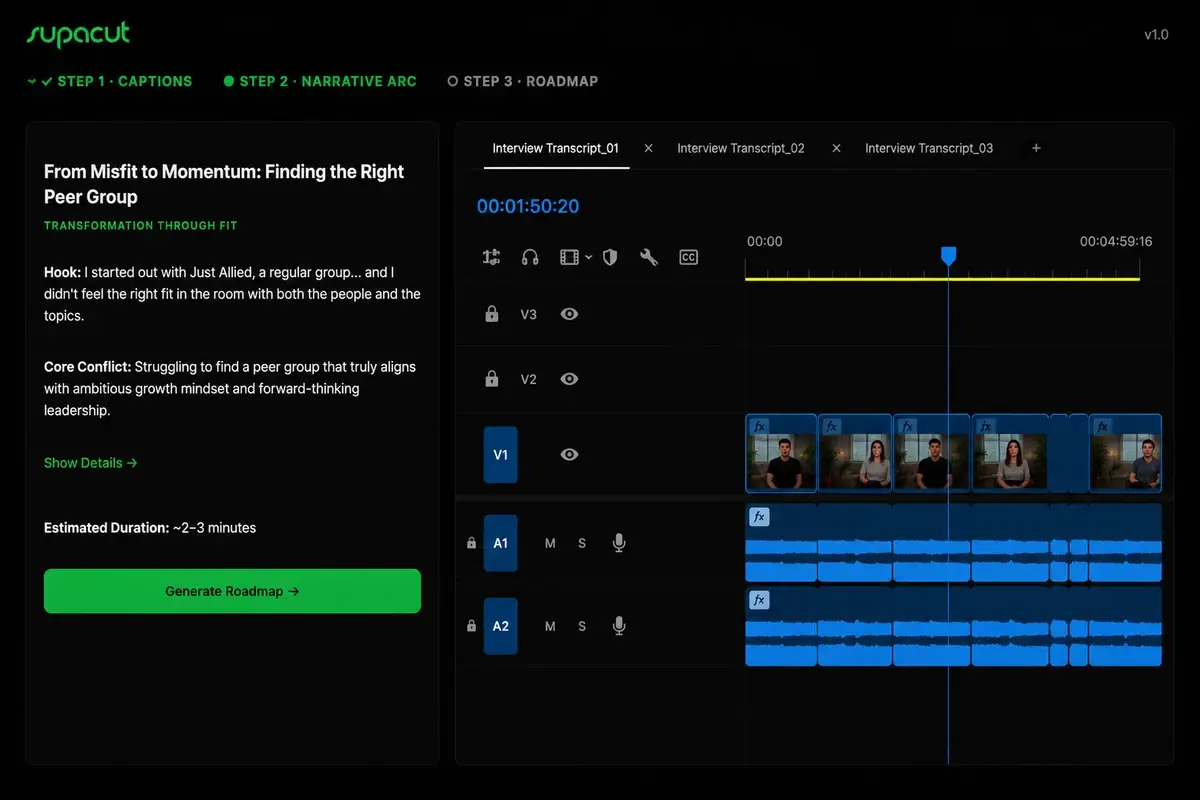
Supacut narrative arc — structure built across all footage simultaneously
Feature by Feature
Workflow-driven comparison
| Criterion | Premiere Text Editing | Best ChoiceSupacut + Premiere Pro |
|---|---|---|
| Role in the Process | Micro-editing tool (trimming phrases, pauses, and stutters) | Editorial exploration tool (themes, comparison, and shortlists) |
| Content Analysis | None — a linear, text-based search engine (Cmd + F) | Advanced — categorizes footage by themes, subtext, and tension |
| Structural Suggestions | No — the editor must know what goes first, second, and last | No — it surfaces possibilities. You decide the story. |
| Multicam / Multi-interview | Clunky — handles text linearly on an active track basis | Intelligent — cross-references and weaves multiple angles together |
| Time to useful material | Hours (selecting and inserting individual sentences) | Faster exploration of themes, quotes, and source footage |
Transformation
Stop staring at a blank timeline and an endless sea of text
Before
- Manually copying and pasting text chunks inside Premiere
- Praying the documentary structure makes sense on the back-end
- Hours lost selecting individual sentences to build a stringout
- Blank-timeline panic with no structural starting point
Now — with Supacut
- Supacut organizes interviews into themes you can actually navigate
- Compare answers and jump to the original source footage
- Shortlist the moments worth taking into the edit
- You decide the story — Supacut does not edit it for you
No credit card required. Export your first Premiere sequence in minutes.