
Generic LLMs write text scripts. Supacut keeps you in the original footage.
Dropping transcript PDFs into a chatbot is a technical headache. Supacut is built for editors: it keeps original quotes, speakers, and timecodes attached to the source footage, so you can explore the material instead of pasting text into a chat box.
The Problem
Why using an office chatbot for professional video editing breaks your workflow
Many editors try to hack their way through the paper-edit by feeding thousands of transcript lines into ChatGPT or Claude. But when it comes to professional post-production, generic models collapse under pressure.
Hallucinations and broken timecodes
ChatGPT routinely alters verbatim quotes, simplifies dialogue, or completely hallucinates timecodes. Finding the actual clip based on an AI's made-up timestamp is an absolute nightmare — every "00:14:32" becomes a search expedition.
Context window drift and forgotten footage
Upload 5 or 10 hours of documentary interviews and generic bots suffer from "middle-of-the-text loss." They forget key talking points buried in your files, or reject the prompt entirely for being too long.
A completely broken bridge to your NLE
The output of a generic LLM is just a block of text in a browser tab. You still have to go back into Premiere, hunt for the exact frames, cut them, and drag them down. It's an unlinked, inefficient island.
The Smart Alternative
An AI built with an editor's eye and a developer's integration
Supacut was built from the ground up exclusively for filmmakers and video editors. It doesn't hallucinate quotes because it is hard-linked to the raw metadata and genuine transcripts of your actual project files.
Our engine groups arguments and emotional beats so you can navigate hours of interviews. It does not give you a chatbot script to decipher — it keeps findings attached to the original footage, so you can explore the material and decide what belongs in the edit.
- Hard-linked to real clip metadata — zero hallucinated timecodes
- Handles multi-hour interview projects without loss or truncation
- Groups arguments and emotional beats by meaning
- Keeps you in the original footage — not a block of text
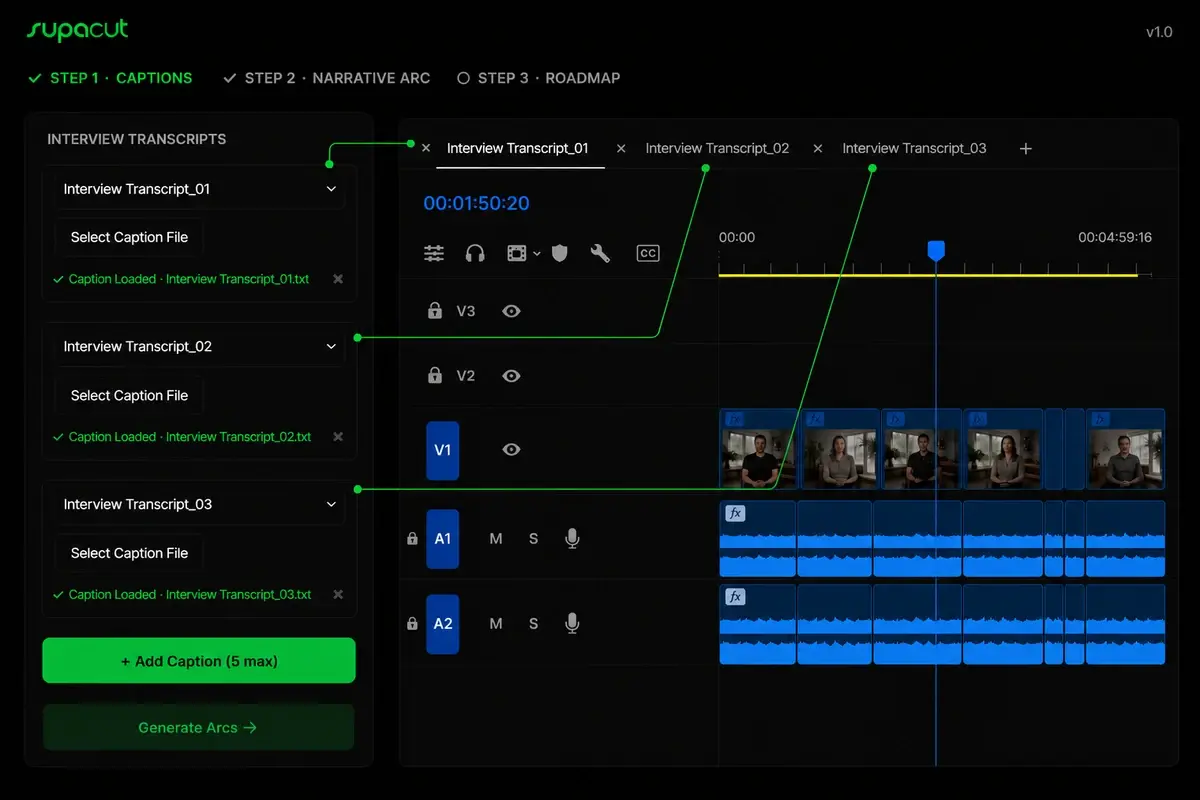
Supacut transcript engine — raw interviews mapped to a frame-accurate Premiere sequence
Feature by Feature
Workflow-driven comparison
| Criterion | ChatGPT / Generic LLMs | Best ChoiceSupacut + Premiere Pro |
|---|---|---|
| Tool Specialization | General purpose (marketing copy, coding, basic text) | Pure post-production and cinematic story architecture |
| Timecode Precision | Horrible — hallucinates, alters, or deletes time stamps | Absolute — lock-tight synchronization with clip metadata |
| Context Window Reliability | Unreliable — dilutes or omits core footage details over time | Built explicitly for massive, multi-hour documentary assets |
| Final Asset Output | Flat text in a browser window that requires manual searching | A native, multi-block sequence injected into Premiere Pro |
| Cinematic Knowledge | Zero understanding of B-roll pacing, talking-head flow, or audio rhythm | Engineered around the structural logic of a professional edit suite |
Transformation
Quit prompt engineering your transcripts. Just edit them.
Before
- Copying massive blocks of transcript text into a chat box
- Getting a broken script with hallucinated timecodes
- Spending all night manually skimming Premiere to find the real clips
- Re-prompting again and again as the context window drifts
Now — with Supacut
- Connect your project footage — no copy-pasting required
- Explore themes, quotes, and source context in one place
- Jump to the original footage instead of hunting by memory
- Every timecode stays attached to the real clip
No credit card required. Export your first Premiere sequence in minutes.